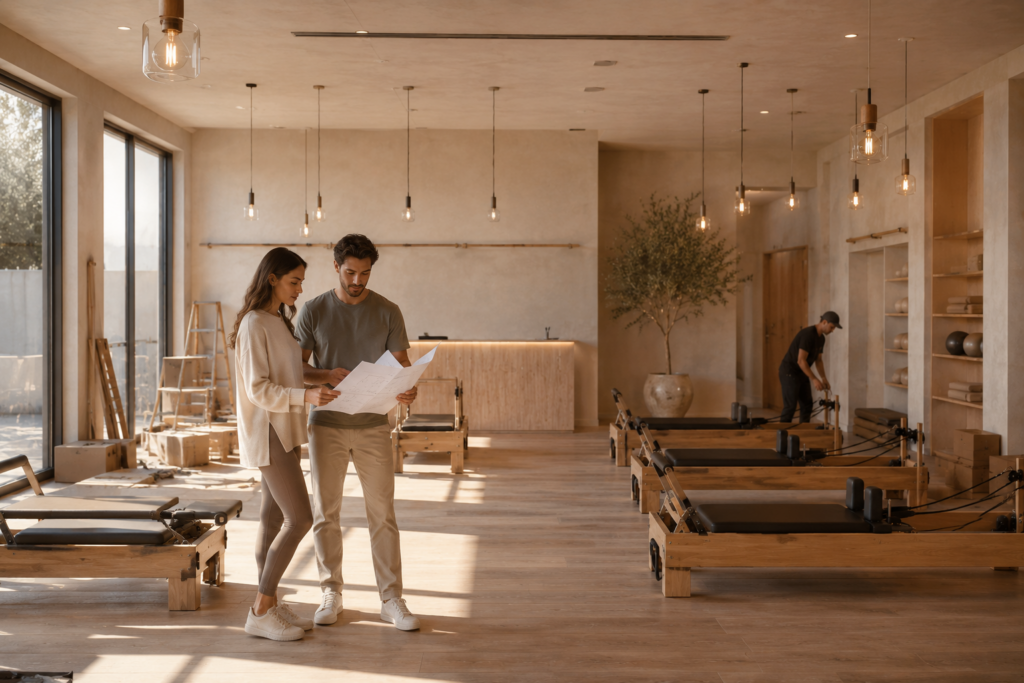
Reformer pilates studios are one of the fastest-growing fitness segments in Switzerland. The combination of low injury risk, visible results, and premium positioning makes reformer studios particularly attractive — both for clients and for the business owners running them.
But setting up a reformer studio requires significantly more planning than a mat-based practice. The equipment is expensive, the space requirements are specific, and the operational model is fundamentally different.
How Much Space Do You Need?
Each reformer requires approximately 2.5 m × 0.7 m of floor space, plus clearance on both ends for spring changes and instructor access. A practical rule: allow 4 m² per reformer when accounting for movement around the equipment.
For a 6-reformer studio — the typical starting point — you need a minimum of 60–70 m² of clear floor space. Factor in reception, changing facilities, and storage, and a realistic total is 90–120 m².
Ceiling height matters: aim for a minimum of 2.8 m to accommodate standing exercises on the reformer.
Choosing Your Reformers
The three dominant reformer brands in the Swiss market are Balanced Body, STOTT PILATES (Merrithew), and Gratz. Each has different positioning.
How you pay for them is a separate decision with real cash-flow consequences: buying, leasing, renting or going used works out very differently over the first year.
- Balanced Body Allegro 2: Most popular in boutique studios, CHF 2,800–3,500 per unit, excellent parts availability
- Merrithew V2 Max: Premium positioning, CHF 4,000–5,500, strong warranty support
- Gratz: Classical Pilates tradition, CHF 4,500–6,000, preferred by classical method instructors
- Used reformers: CHF 800–1,800 per unit — viable if thoroughly inspected by a certified technician
Supporting Equipment
Reformers alone are not enough. A complete reformer studio also needs jump boards (for cardio reformer classes), boxes for seated and lying exercises, footbars with multiple height settings, springs across resistance levels, and at least one tower or Cadillac for private sessions.
Budget an additional CHF 500–1,200 per reformer for accessories.
Equipment-Based Pilates: The Apparatus Explained
"Equipment-based pilates" — apparatus pilates in the trade — covers any pilates practised on a sprung machine rather than on the mat. The reformer is the best known, but it is not the only one.
Which apparatus you buy determines which class formats you can offer, and therefore how you price. A reformer-only studio runs simpler operations; a studio with several apparatus types can charge more for private sessions.
- Reformer: spring resistance lying, seated and standing — the basis for group classes of 6-12
- Cadillac (trapeze table): large apparatus for privates and rehabilitation, highly versatile, space-hungry
- Tower: compact Cadillac alternative, often mounted onto the reformer
- Wunda Chair: small apparatus for strength and balance work, well suited to small groups
- Ladder Barrel and Spine Corrector: supporting apparatus for spinal mobility
Reformers plus one tower are enough to open with. Cadillac and chair only pay for themselves once privates book out regularly.
Ventilation and Flooring
Reformer studios have specific environmental needs. HVAC must handle the heat output of 6–10 people exercising at moderate intensity in a relatively small space. A heat recovery ventilation (HRV) system is worth the investment — your clients will notice if the studio is stuffy.
For flooring, avoid standard gym rubber matting. Reformers need a firm, slightly cushioned surface that does not vibrate. Commercial LVT (luxury vinyl tile) or purpose-built studio flooring (CHF 60–120/m²) is standard in premium reformer studios.
Noise is often overlooked. Reformers on hard surfaces transmit significant vibration. If your studio is above another business or residence, invest in acoustic underlay.
Startup Cost Summary
Here is a realistic budget range for a 6-reformer studio in Switzerland.
- 6 reformers (new): CHF 18,000–33,000
- Accessories and supporting equipment: CHF 4,000–8,000
- Flooring (90 m²): CHF 6,000–12,000
- HVAC/ventilation upgrades: CHF 5,000–15,000
- Mirrors, lighting, reception furniture: CHF 8,000–15,000
- Booking and management software: CHF 29–99/month (StudioPlan)
- Total: CHF 41,000–83,000 before lease and fit-out costs
Mat or Reformer? Deciding Before You Commit
Not every pilates studio needs reformers. A mat studio opens for a fraction of the cost — CHF 5,000–15,000 covers mats, props, mirrors and basic flooring — and can run 15–20 clients per class instead of 6–10. The trade-off is revenue per head: mat classes in Switzerland sell for CHF 25–35, reformer classes for CHF 38–55.
The honest test is your local market. In a city with several established reformer studios, a well-positioned mat studio with strong instructors can be the better business. In a town with none, reformer is the differentiator worth the capital.
- Mat studio: CHF 5,000–15,000 setup, 15–20 clients per class, CHF 25–35 per class
- Reformer studio: CHF 41,000–83,000 setup, 6–10 clients per class, CHF 38–55 per class
- Hybrid: a reformer room plus a mat room — highest revenue per m², highest operational complexity
Many Swiss studios open mat-only and add reformers in year two, funded by the client base the mat classes built.
Permits, Insurance and Legal Setup in Switzerland
Before signing a lease, confirm with the local Bauamt that the premises are zoned for commercial sports use. Converting retail or office space into a studio usually requires a change-of-use permit (Nutzungsänderung), which takes two to four months and can trigger fire-safety and accessibility requirements.
You will also need business liability insurance (Betriebshaftpflicht) — typically CHF 400–900 a year for a studio this size — and accident cover for employed instructors through SUVA or a private carrier.
- Company registration (Einzelfirma or GmbH): CHF 300–1,000 depending on structure
- Change-of-use permit where required: CHF 500–3,000, two to four months
- Business liability insurance: CHF 400–900 per year
- Equipment insurance: CHF 200–500 per year for CHF 30,000+ of reformers
- SUISA music licence: from roughly CHF 350 per year if you play music in classes
Ask the landlord in writing whether the premises already carry a commercial sports use permit. Finding out they do not, after signing, is the most expensive mistake in studio setup.
What It Costs to Run, Month to Month
Startup capital gets the attention, but the monthly figure decides whether the studio survives. For a 6-reformer studio in a mid-sized Swiss city:
- Rent for 90–120 m²: CHF 2,500–5,500 depending on city and location
- Instructor pay: CHF 60–110 per class, or CHF 4,000–6,500 per month for an employed lead instructor
- Utilities and heating: CHF 250–500
- Insurance, licences and accounting: CHF 200–400
- Booking and management software: CHF 29–99
- Marketing: CHF 300–1,000
- Maintenance and spring replacement: CHF 100–200 amortised
- Realistic monthly total: CHF 7,000–14,000
Working Out Your Break-Even
The arithmetic is simple and worth doing before you sign anything. Take your monthly operating cost, divide by average revenue per class, and you have the number of classes you need to fill.
A studio with CHF 9,000 of monthly costs, 8 reformers and an average of CHF 42 per client at 70% occupancy earns roughly CHF 235 per class. That studio breaks even at about 38 classes a month — roughly 9 to 10 classes a week, before the owner takes anything.
Most studios get there between months four and eight. Budget at least six months of costs in reserve, and treat any first-month projection that assumes full classes as fiction.
Track revenue per available reformer-hour rather than headcount. It is the number that tells you whether to add classes, raise prices, or cut a poorly attended slot.
Hiring and Keeping Instructors
Equipment does not fill classes; instructors do. Reformer-qualified instructors are genuinely scarce in Switzerland, and the good ones are usually already teaching somewhere.
Expect CHF 60–110 per class for freelancers, more for someone bringing their own following. Comprehensive certification (Balanced Body, Merrithew, BASI, Polestar) takes 400–500 hours and costs CHF 6,000–12,000 — often better spent developing a promising mat instructor than competing for scarce senior hires.
- Freelance reformer instructor: CHF 60–110 per class
- Employed lead instructor: CHF 4,000–6,500 per month full-time
- Sponsored comprehensive certification: CHF 6,000–12,000, usually with a two-year commitment
- Cover instructors: have at least two trained on your schedule before you open
The Mistakes That Cost the Most
Five recurring errors account for most of the studios that struggle in their first year.
- Signing a lease before confirming the change-of-use permit — months of rent on premises you cannot open
- Buying eight reformers when six would have filled — capital tied up in equipment that sits idle
- Underestimating ventilation — the most common complaint in studio reviews
- No waitlist, so every cancellation becomes an empty spot instead of a filled one
- Opening without a booking system, then migrating client data out of WhatsApp and spreadsheets six months later
Managing Your Reformer Studio with StudioPlan
Reformer sessions typically run 50–55 minutes with strict capacity: one client per reformer. StudioPlan helps you set class capacity, manage instructors, track bookings, handle waitlists, and connect payments or class credits to the booking flow.
That gives a reformer studio the operational structure it needs without relying on spreadsheets or manual message threads.
If you are still comparing platforms, what to look for in pilates and yoga studio software covers the features that matter for apparatus classes and the questions worth asking every vendor.
When you want specifics rather than criteria, our pilates studio management software sets out how StudioPlan handles apparatus capacity, instructor pay and class credits.