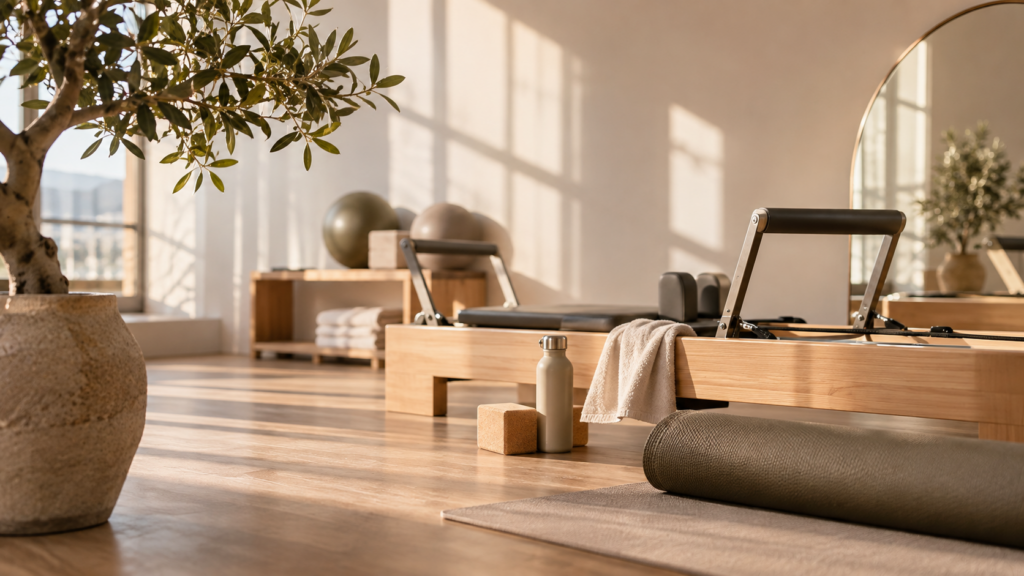
Opening your own Pilates studio is realistic if you settle three things first: how many clients you need each month, what the start costs, and how long your cash buffer lasts until the studio carries itself. This guide walks you through the decisions that matter most for studios in Switzerland, in order.
Note: all figures are planning guidance. Rents, equipment prices and requirements vary by canton and municipality. Have the key points confirmed by your accountant or municipality before you sign.
1. Choose your studio model
The model determines space, equipment and pricing.
- Mat Pilates: lowest start-up costs, good for groups, but little differentiation from other providers.
- Reformer studio: higher investment, but higher prices per class and smaller groups. More in our guide to setting up a reformer Pilates studio.
- Hybrid: mat plus a few machines, private sessions on the reformer, groups on the mat. For many new studios the best compromise.
2. Work out the start-up costs
Plan for these items and complete them with real quotes:
- Equipment: compare buying, leasing and renting in Pilates equipment: buy, lease or rent.
- Space: deposit, fit-out, flooring, mirrors, changing area, toilets.
- Insurance: business liability, inventory, professional liability.
- Software and website: booking system, payment processing, domain. See the pricing page for terms.
- Marketing: opening offer, photos, local advertising.
- Cash buffer: at least three to six months of fixed costs.
3. Find the right space
Look at public transport access, parking, ceiling height, sound insulation towards neighbours and whether use as a studio is permitted. Ask the municipality whether the fit-out or change of use needs a permit.
4. Legal form, insurance and permits
Most people start as a sole proprietorship or a GmbH (limited liability company). A sole proprietorship is quicker to set up, a GmbH separates private and business assets. Clarify your self-employed status with your compensation fund (Ausgleichskasse) and VAT with your accountant (mandatory from CHF 100,000 annual turnover). If you employ or contract instructors, settle employment versus contract early, see paying Pilates and yoga instructors.
5. Pricing and break-even
Work backwards: monthly fixed costs divided by the contribution margin per class tells you how many well-filled classes you need. Typical offers are single classes, 10-class cards and memberships. Fill rate and repeat visits matter, not the highest single price. Start with a few clear offers and adjust them after the first three months.
6. Set up booking, payment and administration
Clients expect to book online and pay with TWINT or card. You need a waitlist, reminders against no-shows, memberships and class cards, invoices and reporting in one system. See how StudioPlan differs from other solutions in the comparison and the features.
7. Checklist for the first 90 days
- Weeks 1 to 4: business plan, financing, space, legal form, insurance.
- Weeks 5 to 8: fit-out, equipment, booking system, class schedule, website, pricing.
- Weeks 9 to 12: opening offer, trial classes, first feedback, adjust prices and times.