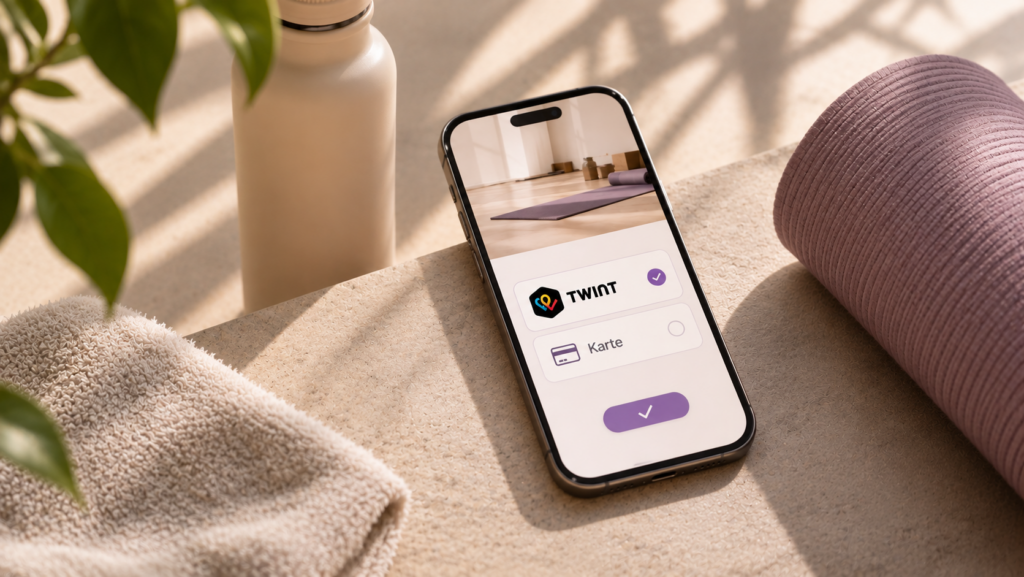
Your classes and memberships are selling, your timetable is filling up, and part of every online sale goes towards collecting the payment. To lower transaction fees, start with your payment mix. For a Swiss yoga, Pilates or fitness studio, TWINT can cost less than cards. What matters is how much remains after processing fees and reward costs.
1. Understand the cost of each payment
Choose a completed month. How much revenue came through each method? How many payments were made? What fees were actually charged? Separate payment processing, any platform or service charges, and your software subscription. Switching payment methods does not automatically reduce every cost.
Calculate by method: effective fee rate = allocated payment fees ÷ paid revenue × 100. Use the same period and currency. Track refunds separately so the comparison stays understandable. Your actual agreement matters more than a headline percentage.
2. Compare transaction fees with TWINT
StudioPlan’s processing rates through Stripe are 2.9% + CHF 0.30 for Swiss cards and 1.9% + CHF 0.30 for TWINT. On CHF 100, that is CHF 3.20 versus CHF 2.20: a calculated CHF 1.00 difference. Checked on 24 October 2026: Stripe card pricing and Stripe TWINT pricing.
TWINT processing therefore costs less than Swiss card processing in StudioPlan: the fixed fee is the same and the percentage fee is one percentage point lower. For your overall budget, consider your StudioPlan software subscription and loyalty reward costs separately.
3. Give clients a reason to choose TWINT
A simple invitation can make the choice attractive: “Pay with TWINT and earn 20 extra loyalty points.” Your class price stays the same. You determine what those points are worth through the rewards in your program.
In StudioPlan, open Products → Promotions & Rewards → Points Earning Rules, enable TWINT payment, enter a fixed number of points and save. The loyalty program must also be active. The bonus applies per successful supported CHF payment, regardless of amount. Zero or a disabled rule means no bonus. Follow the TWINT loyalty bonus guide.
Class and product payment choices show the offered bonus. Points appear in the client’s history after payment confirmation. Supported outstanding class payments collected through a TWINT link can qualify too. Opening the link alone does not earn points.
4. Budget for rewards before promising points
A deliberately simple example: your actual processing-fee difference is CHF 1.00 per payment. You award 20 extra points. Suppose 500 points unlock a reward with an incremental cost of CHF 5 to your studio. At full redemption, this bonus represents 20 ÷ 500 × CHF 5 = CHF 0.20 in reward costs. CHF 0.80 of the fee advantage remains.
If 300 payments with this profile genuinely move from cards to TWINT, that gives a calculated CHF 240 after these rewards, before other costs. This is an illustration, not a forecast. Clients who already used TWINT receive the active bonus too. Their additional rewards belong in the budget even though these payments create no new processing-fee savings.
A fixed bonus costs the same on a small payment as on a large one. Check your smallest typical purchase too. Splitting payments just to collect more points would increase both reward costs and fixed processing fees.
5. Measure the result after a month
Compare the TWINT share, paid revenue, effective fees and cost of the extra points. Watch abandoned purchases and support questions too. A cheaper payment mix does little good if clients stop booking. Keep suitable alternatives available and start with a modest bonus.
Payment count matters as well: fixed fees repeat with each transaction. A well-designed class package can reduce separate payments, provided it suits your clients‘ training needs. For invoice payments, include manual reconciliation and non-payment risk in the comparison.
What happens after a refund
StudioPlan withdraws the entire fixed TWINT bonus once if a payment is partially or fully refunded. The reversal uses the original number of points. If points were already redeemed, the balance stops at zero under the existing loyalty rule. Explain this clearly: the client guide covers it in everyday language.
Start with your actual fees, an affordable reward and a clear measurement period. StudioPlan brings bookings, payments and loyalty into one place.