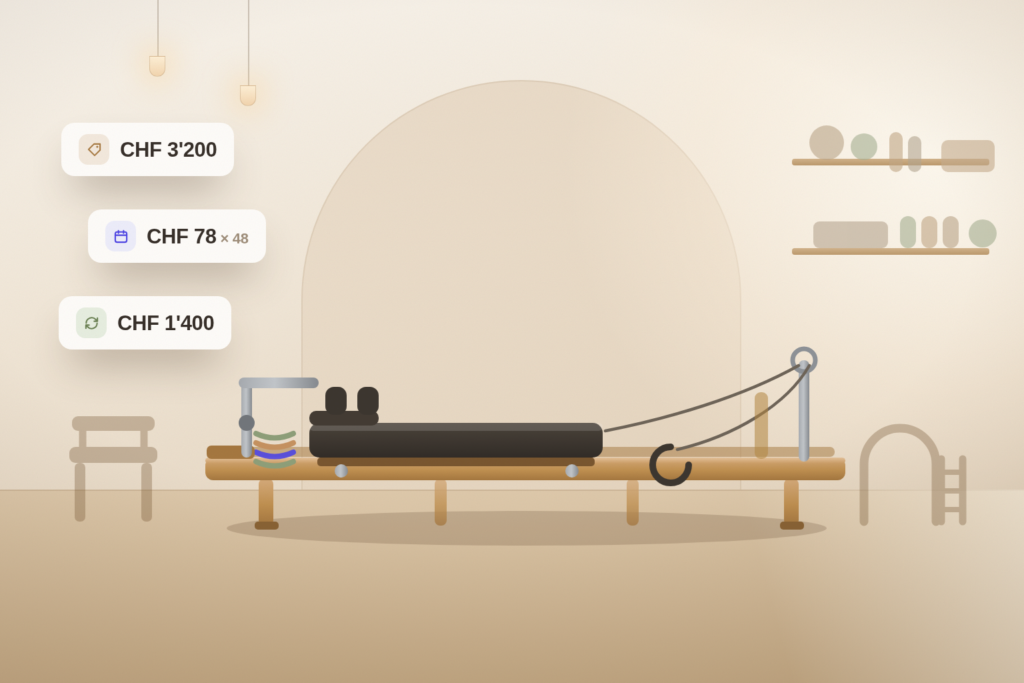
Equipment is the largest single decision in opening an apparatus-based pilates studio, and the one most often made on instinct. Owners walk into a supplier showroom, fall in love with a machine, and commit CHF 30,000 before working out how many hours a week that machine will actually be used.
The equipment itself is only part of the question. How you finance it changes your monthly break-even, your flexibility if demand turns out different from your forecast, and how quickly you can add a second room. A studio that leases six reformers and a studio that buys six reformers have identical timetables and very different balance sheets.
This guide covers what each piece of apparatus costs in Switzerland, how many you need, the four ways to acquire them, and the running costs that rarely make it into an opening budget.
What "Pilates with Equipment" Actually Means
Pilates with equipment — apparatus pilates — covers a family of machines Joseph Pilates designed, each with a different role. Studios rarely need all of them, but knowing what each does prevents both over-buying and awkward gaps in your programme.
- Reformer: the carriage-and-spring machine that defines the category. It carries roughly 80% of what a group class does, and it is the machine clients book
- Tower or half-trapeze: a frame added to a reformer, adding springs from above. Doubles the exercise range for a fraction of a full Cadillac
- Cadillac / trapeze table: the full apparatus, mostly used in privates and rehab work. One is enough for most studios
- Wunda chair: compact, brutal, excellent for strength and for small spaces. Two chairs fit where one reformer does
- Ladder barrel and spine corrector: extension and mobility work, and the cheapest way to broaden a programme
- Springboard: a wall-mounted spring system. The lowest-cost route to apparatus work in a mat studio
If you are unsure whether to go apparatus-based at all, a springboard wall is the cheapest genuine test: roughly CHF 700–1,200 per station, mounted in a mat studio, giving you real demand data before you commit to reformers.
What Each Apparatus Costs in Switzerland
Prices vary by brand and by whether you buy through a Swiss distributor or import directly. Importing can be cheaper on paper, but factor in customs, VAT, delivery to a first-floor studio, and the absence of a local technician when a spring anchor fails.
- Reformer, entry-level commercial: CHF 2,400–3,200 per unit
- Reformer, premium (Merrithew, Gratz, higher Balanced Body ranges): CHF 4,000–6,000
- Tower attachment: CHF 900–1,800 per reformer
- Cadillac / trapeze table: CHF 4,500–8,000
- Wunda chair: CHF 1,200–2,400
- Ladder barrel: CHF 900–1,600. Spine corrector: CHF 250–450
- Springboard station: CHF 700–1,200
- Accessories per reformer — box, jump board, extra springs, straps: CHF 500–1,200
Ask every supplier two questions before price: what is the lead time, and who services it in Switzerland. A twelve-week delivery on reformers can push your opening date past your lease start, and that is expensive in a way the invoice never shows.
How Many You Actually Need
The most common opening mistake is buying capacity for the studio you hope to have in year three. Reformers that sit idle are capital you cannot spend on marketing, and an eight-reformer class that runs at five is harder to fill than a six-reformer class that runs at five.
A workable Swiss configuration for a first studio is six reformers, two of them with tower attachments, one chair, one ladder barrel and a set of small props. That equips group classes, privates and duets, and comes to roughly CHF 22,000–32,000 including accessories.
Add reformers when your peak classes are consistently full and your waitlists are consistently active — those two signals together are the only reliable case for more equipment.
Buying Outright
Buying is the cheapest route over the life of the equipment. A commercial reformer lasts ten to fifteen years with proper maintenance, so a CHF 3,200 machine costs roughly CHF 20–27 a month spread across its life. There is no interest, no contract, and the asset is yours to sell.
The cost is cash flow. Six reformers plus accessories is CHF 22,000–32,000 leaving your account in the month you are also paying a lease deposit, a fit-out and your first marketing. That is precisely the month in which studios run out of runway.
Buying makes sense when you have the reserves to do it without eating into your six-month operating buffer, and when you are confident about demand — usually because you already teach and have clients who will follow you.
Leasing
Equipment leasing spreads the cost over 36 to 60 months and keeps your opening capital intact. In Switzerland, a CHF 3,200 reformer typically leases at roughly CHF 70–90 a month over 48 months, which puts six reformers at CHF 420–540 monthly.
Over the term you pay perhaps 12–20% more than the purchase price. In exchange you keep CHF 20,000 of working capital during the period when a new studio most needs it, and the payment is a predictable operating cost rather than a hole in your reserves.
Read three clauses carefully: what happens at the end of the term (transfer of ownership, a residual payment, or return), whether early settlement is possible and at what cost, and whether the lease requires equipment insurance you do not already hold. Most Swiss providers will want a personal guarantee from a new business, so understand what you are signing personally.
Compare the total paid over the term against the purchase price, not the monthly figure against your gut feeling. A lease that costs 15% more but keeps you solvent through month six is a good trade. One that costs 40% more is a loan wearing a disguise.
Renting and Rent-to-Own
Short-term rental is the least common route and the most useful in three specific situations: testing demand in a new location, running a pop-up or seasonal offer, and covering a machine that is out for repair during a busy term.
Expect roughly CHF 150–250 per reformer per month on a short term, which is expensive as a permanent arrangement but cheap as an experiment. Some suppliers offer rent-to-own, where a portion of the rental is credited against a later purchase — worth asking about explicitly, because it is rarely advertised.
The honest case for renting is information. Three months of rented reformers in a room you already pay for tells you more about local demand than any market study, and costs less than discovering the same thing after buying six machines.
The Used Market
Used reformers sell in Switzerland for CHF 1,000–2,000, usually because a studio closed or upgraded. At roughly half the price of new, it is the fastest way to equip a studio on a limited budget — provided you inspect properly.
Check the frame for cracks and any repair welds, the rails for pitting or flat spots, and the wheels for play; run the carriage through its full range listening for grinding. Test every spring for corrosion and consistent tension, and check the spring anchors and hooks, which are the most common failure point. Inspect the upholstery for tears and, more importantly, for compression — a flat pad means heavy use. Confirm that footbar and headrest adjustments still lock securely, and ask the age, the studio it came from and whether it was ever serviced.
Budget CHF 200–500 per used machine for new springs, ropes and upholstery. That still leaves you well ahead, and a refurbished commercial reformer will serve a studio for years.
Never buy a used commercial machine unseen from photographs. If you cannot inspect it yourself, pay a technician CHF 150 to do it. A cracked frame is not repairable and is not always visible in a listing.
The Running Costs Nobody Budgets
Equipment is not a one-off purchase; it is a maintenance schedule. Springs lose tension and need replacing every two to four years depending on use. Ropes and straps stretch and fray, and should be checked monthly and replaced annually in a busy studio. Upholstery compresses and looks tired long before it fails — and clients notice.
For a six-reformer studio, budget CHF 1,200–2,400 a year across springs, ropes, upholstery refresh, wheel and rail servicing, and an annual technician visit. That is CHF 100–200 a month, and it is the line most often missing from an opening budget.
Add equipment insurance at CHF 200–500 a year for a studio carrying CHF 30,000 of apparatus, and keep the purchase invoices — insurers ask for them at exactly the wrong moment.
A Decision Framework
Five questions settle the buy, lease, rent or used decision faster than any spreadsheet:
- After equipment, do you still hold six months of operating costs in reserve? If not, do not buy outright
- Do you already have clients who will follow you? Confident demand justifies owning; uncertain demand argues for leasing or renting
- Is the space permanent? A short or uncertain lease makes owning fixed equipment a risk
- Can you inspect used machines competently, or pay someone who can? If yes, used is the best value in the market
- Would the cash saved by leasing be spent on something that grows the studio — or would it just sit there?
A common and sensible Swiss pattern: buy four reformers used, lease two new ones, and keep the difference as marketing budget for the first six months. Mixed sourcing is not a compromise — it is usually the best-run version of the decision.
Making the Equipment Pay for Itself
Once the machines are in the room, the number that matters is revenue per reformer-hour. Take the revenue of a class and divide it by the number of machines and the hours they were occupied. A full six-person class at CHF 42 is CHF 252 for the hour, or CHF 42 per reformer-hour. The same class at four people is CHF 28.
That single number tells you more than occupancy percentages. It shows which slots deserve another class, which should be turned into privates at a higher rate per machine, and which should be cut. It also tells you honestly whether a seventh reformer would earn anything.
Getting there requires knowing your real occupancy, not your impression of it — which is where a booking system that tracks capacity, waitlists and attendance per class stops being administration and starts being the thing that pays for the equipment.
Running an Apparatus Studio with StudioPlan
Apparatus classes have hard capacity: one client per reformer, no exceptions. StudioPlan enforces capacity per class, handles privates and duets alongside group sessions, and promotes from the waitlist automatically when someone cancels — which is what turns an empty machine back into a paid hour.
Attendance and revenue per class are visible without exporting anything, so revenue per reformer-hour is a number you can actually look at rather than reconstruct. Booking, class packs and payments run in CHF through your own Stripe account, in German, French, Italian and English.
Equipment is the capital decision. Filling it week after week is the operational one — and that is the part that decides whether the machines pay for themselves.
If you are still at the planning stage, how to set up a pilates studio covers space, permits and break-even, and mat vs. reformer works through which format your local market will actually support.